Sofia Ludwig · 17 September 2026
UV Exposure Effects on Pigment Stability in Vibrant Flooring Materials for Commercial Spaces
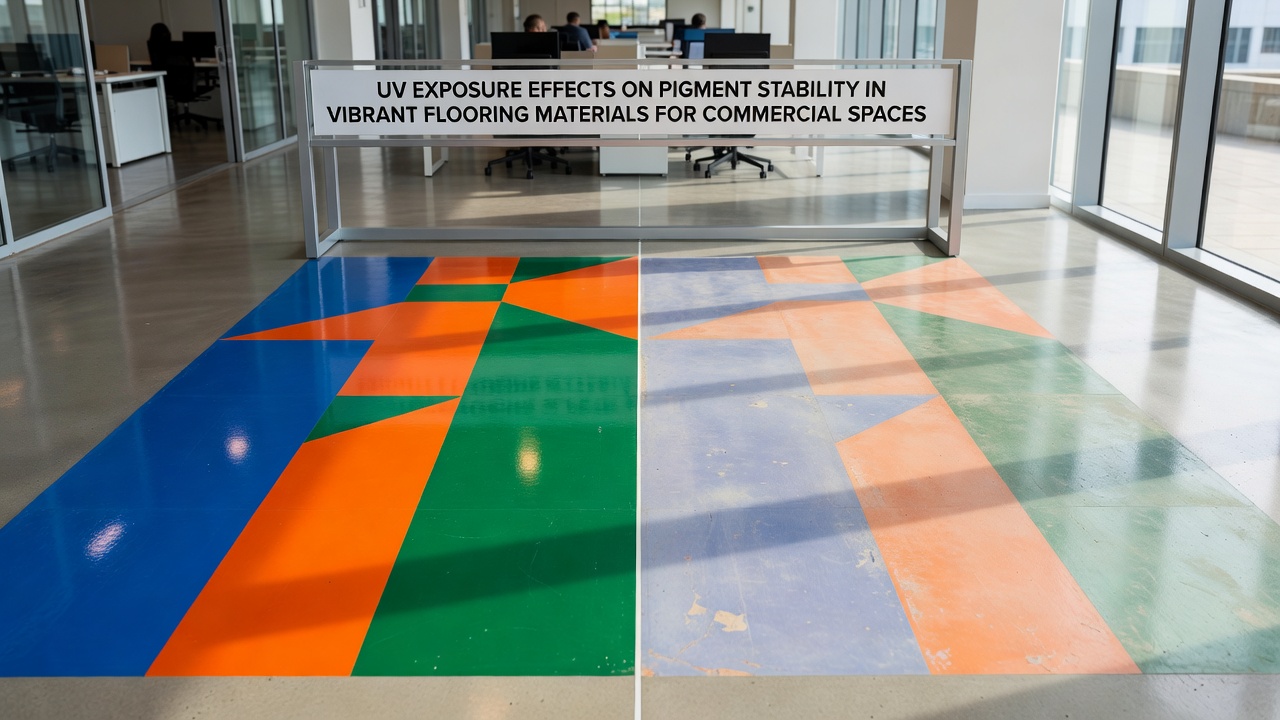
Commercial spaces rely on vibrant flooring to create visual appeal and brand identity, yet ultraviolet radiation from sunlight and artificial sources accelerates pigment breakdown in many materials. UV photons penetrate surface layers, trigger chemical reactions in organic colorants, and produce visible fading over months or years of exposure. Researchers track these changes through accelerated weathering tests that simulate years of sunlight in weeks, revealing consistent patterns across vinyl, epoxy, and rubber compounds used in retail floors, office lobbies, and hospitality corridors.
Mechanisms Driving Pigment Degradation
UV light in the 290-400 nm range excites electrons in dye molecules, leading to bond cleavage and formation of free radicals that attack neighboring polymer chains. This process alters chromophore structures responsible for color, shifting hues toward yellow or gray while reducing saturation. Studies conducted by materials laboratories show that certain azo pigments lose 30 percent of their original chroma after 500 hours of UVA exposure, whereas inorganic alternatives such as titanium dioxide stabilized iron oxides retain more than 85 percent under identical conditions. Temperature and humidity amplify these reactions because heat increases molecular mobility and moisture facilitates hydrolysis of weakened bonds.
Performance Differences Across Flooring Types
Vinyl compositions with plasticizers exhibit faster surface chalking and color shift compared with polyurethane-modified systems that incorporate UV absorbers. Epoxy terrazzo floors, popular in high-traffic airports, demonstrate better initial resistance when formulated with hindered amine light stabilizers, yet prolonged exposure still causes micro-cracking that exposes underlying pigments to further attack. Carpet tiles containing solution-dyed nylon fibers maintain color longer than those using post-dyeing methods, because the pigment integrates into the polymer melt before extrusion. Data collected across multiple installations indicate that south-facing retail entrances experience measurable fading within 18 months, whereas shaded interior zones show minimal change over the same period.
Testing Standards and Measurement Protocols
Accelerated testing follows methods outlined by ASTM International, including ASTM G154 for fluorescent UV exposure and ASTM D3424 for lightfastness evaluation of flooring samples. Color change registers through CIE L*a*b* coordinates, with Delta E values above 2.0 considered noticeable to the human eye. European laboratories apply EN ISO 105-B02 protocols that correlate xenon-arc results with real-world sunlight hours, allowing specifiers to predict service life more accurately. In September 2026, updated reporting from the European Committee for Standardization will introduce revised exposure cycles that account for higher UV indices observed in southern European climates.
Mitigation Approaches in Practice
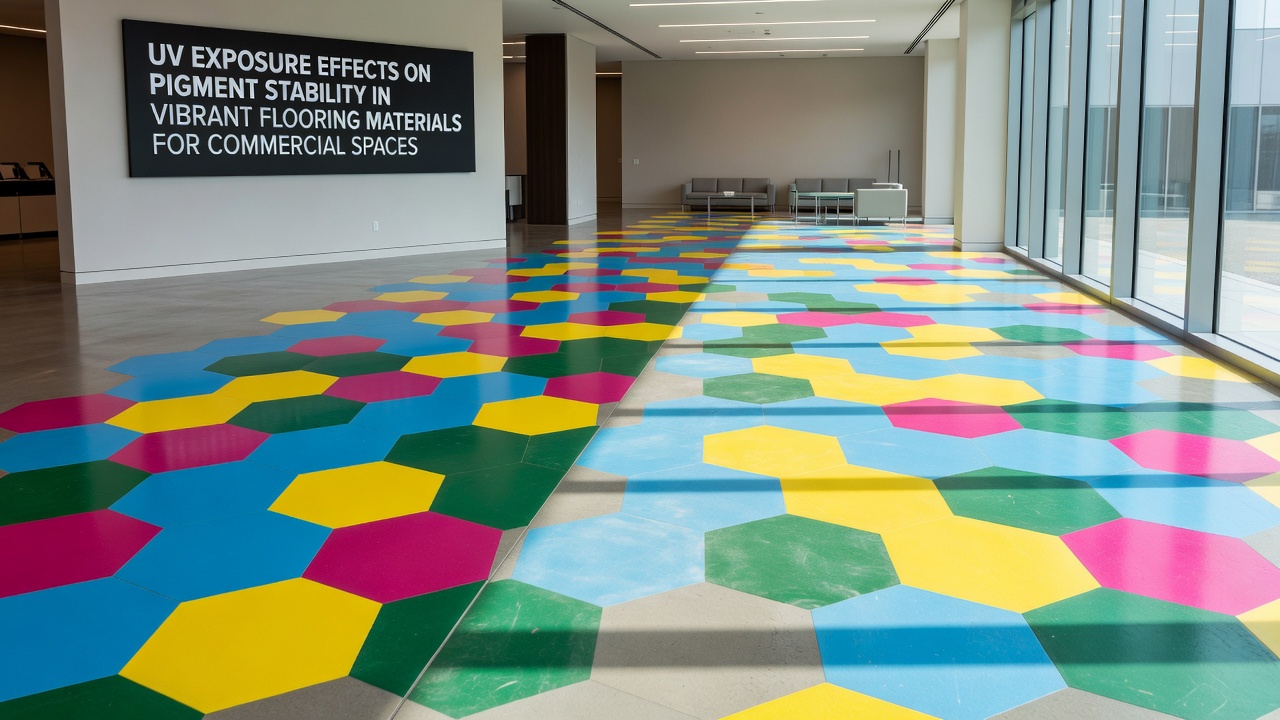
Specifiers increasingly select flooring with built-in UV protection packages that combine benzotriazole absorbers and radical scavengers. Window films rated to block 99 percent of UVA and UVB wavelengths reduce incident radiation on perimeter zones, extending pigment life without altering interior lighting design. Maintenance teams apply sacrificial coatings containing zinc oxide nanoparticles that reflect UV while preserving slip resistance. One installation at a Canadian shopping complex combined these measures and recorded Delta E values below 1.5 after three years, compared with 4.8 in control areas lacking protection. Regular cleaning removes surface contaminants that can otherwise act as photosensitizers and accelerate localized fading.
Implications for Facility Planning
Facility managers factor UV exposure into material selection during renovation cycles because replacement costs rise when color inconsistency appears in high-visibility zones. Insurance assessments sometimes reference fading rates when evaluating claims for premature wear in sunlit atriums. Digital modeling tools now integrate solar path data with material databases, enabling designers to predict pigment performance across building orientations before installation begins. These tools draw on spectral irradiance measurements collected by meteorological networks and translate them into expected service-life estimates for specific product formulations.
Conclusion
UV exposure remains a primary driver of pigment instability in commercial flooring, yet documented testing methods and protective formulations allow accurate forecasting of color retention. Continued refinement of stabilizer chemistry and updated international standards support longer service intervals while preserving the visual impact required in retail and hospitality environments.